
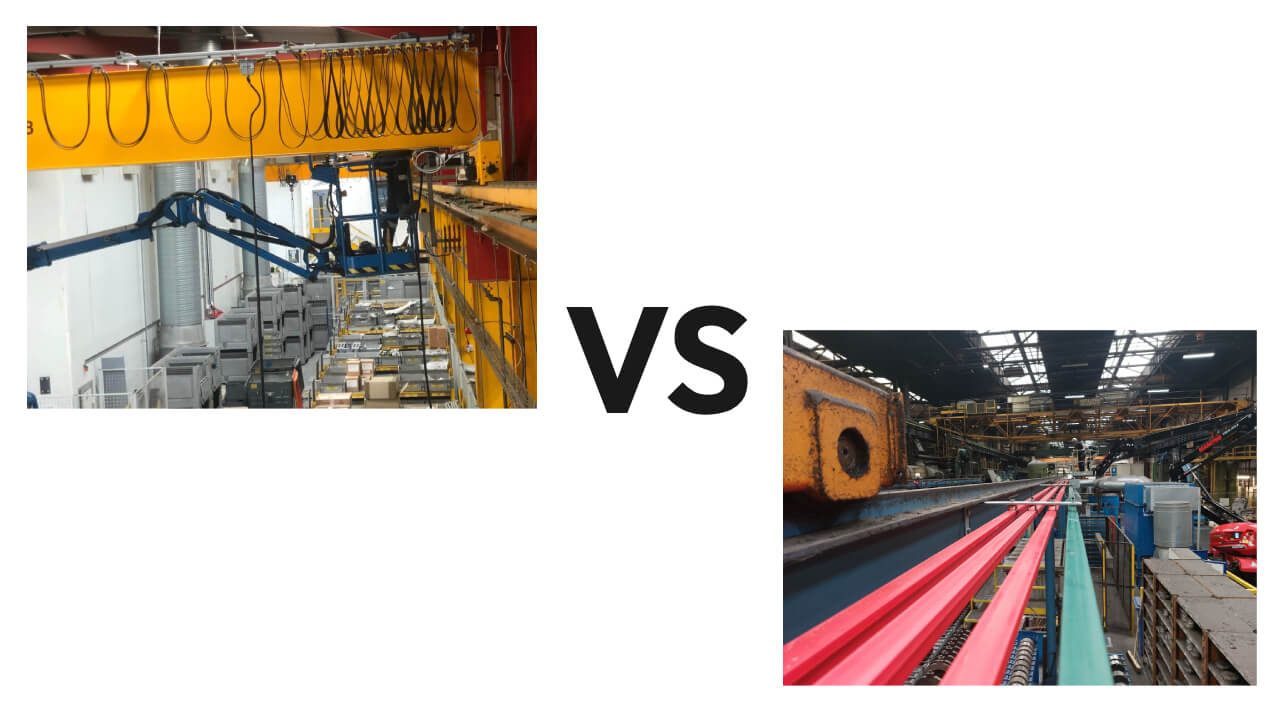
Every overhead crane needs a way to deliver electrical power from a fixed supply to the moving crane or hoist. The two main options are festoon systems and conductor bar (busbar) systems – each with distinct advantages depending on your application, duty cycle, and environment. This guide compares both to help you make the right choice.
Two Ways to Power a Travelling Crane
When a crane travels along a runway, it needs continuous electrical power for the hoist, trolley, and bridge motors. Unlike stationary equipment, you can’t just plug it in – you need a system that moves with the crane while maintaining a reliable connection.
Both systems do the same job – but they work very differently and suit different applications.
Festoon System
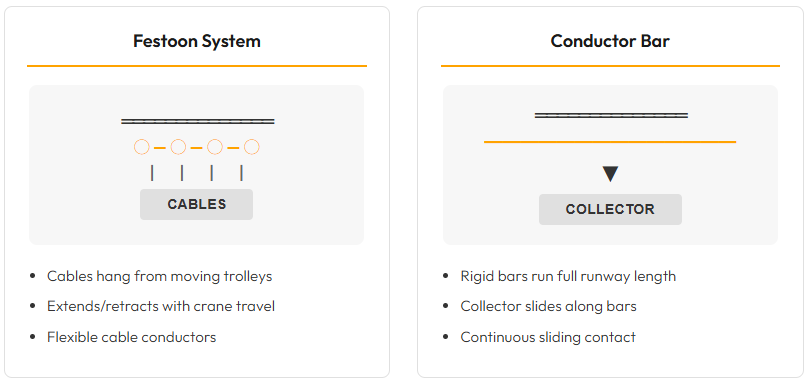
Cables suspended from trolleys that travel along a track. The cables extend and retract as the crane moves, carrying power and control signals through flexible conductors.
Conductor Bar (Busbar)
Rigid copper or steel bars mounted along the runway. Collector shoes attached to the crane slide along the bars, picking up power through continuous contact.
How They Work
Festoon vs Conductor Bar: Quick Comparison
| Factor | Festoon System | Conductor Bar |
|---|---|---|
| Initial cost | Lower upfront cost | Higher upfront cost |
| Maintenance | Cable replacement over time | Lower ongoing maintenance |
| Duty cycle | Light to moderate duty | High duty / continuous use |
| Travel speed | Moderate speeds (up to ~60m/min) | Higher speeds possible (100m/min+) |
| Travel distance | Short to medium runs | Long runs (virtually unlimited) |
| Data/control signals | Easy – cables carry power and data | Separate system often needed |
| Environment | Good in dusty/dirty areas (enclosed track) | Sensitive to contamination |
| Safety | Cables fully enclosed | Finger-proof designs available |
| Installation | Quicker, simpler | More complex alignment |
When to Use a Festoon System
A festoon system is often the right choice when:
- Budget is a concern – festoon systems typically cost less to purchase and install than conductor bar systems.
- Travel distances are short to medium – festoon works well for runs up to around 50-80 metres, though longer is possible.
- Duty cycle is light to moderate – occasional use or intermittent operation, rather than continuous high-speed travel.
- You need to carry data and control cables – festoon can carry power, control signals, and data cables in one system.
- The environment is dusty or dirty – enclosed C-track festoon protects cables and trolleys from contamination.
- Quick installation is required – festoon is generally faster to install than conductor bar.
- Retrofit situations – easier to add to existing cranes without major modifications.
Typical Festoon Applications
- Light to medium duty overhead cranes
- Monorail systems and hoists
- Gantry cranes with moderate travel
- Workshop and fabrication cranes
- Applications requiring data/network cables alongside power
When to Use a Conductor Bar System
A conductor bar (busbar) system is the better choice when:
- High duty cycle or continuous operation – conductor bars handle frequent, intensive use better than cables.
- Long travel distances – busbars can run the full length of a building with no practical limit.
- High travel speeds – conductor bars support faster crane travel without cable wear concerns.
- Multiple cranes on one runway – several cranes can draw power from the same conductor bar system.
- Minimising long-term maintenance – once installed, conductor bars require less ongoing attention than cables.
- High current requirements – conductor bars can carry higher amperages more efficiently.
- Clean, controlled environments – where contamination is minimal and bars can be kept clean.
Typical Conductor Bar Applications
- High-duty production cranes
- Automated and semi-automated cranes
- Long runway installations
- Steel mills and heavy industry
- Multi-crane runways
- Process cranes with continuous operation
Which System Do You Need? A Quick Decision Guide
Safety Considerations
Both systems can be designed for safe operation, but they have different safety characteristics:
Festoon System Safety
Cables are typically enclosed within the C-track or festoon housing, keeping them away from personnel. There’s no exposed live conductor – the power is contained within the cable insulation.
Conductor Bar Safety
Traditional open conductor bars have exposed live surfaces, which presents a risk of accidental contact. However, modern finger-proof (shrouded) conductor bar designs enclose the live conductors within a protective housing, allowing only the collector shoe to make contact.
Summary
Choose Festoon if:
- Travel distance is under 50m
- Duty cycle is light to moderate
- You need to carry data cables
- Environment is dusty or dirty
- Budget is constrained
- Quick installation is needed
Choose Conductor Bar if:
- Travel distance is long
- Duty cycle is high/continuous
- High travel speeds required
- Multiple cranes share runway
- Lower long-term maintenance preferred
- Environment is clean
Related Posts
What are the characteristics of European cranes?
Cranes are essential core handling equipment in modern factories, warehouses,…
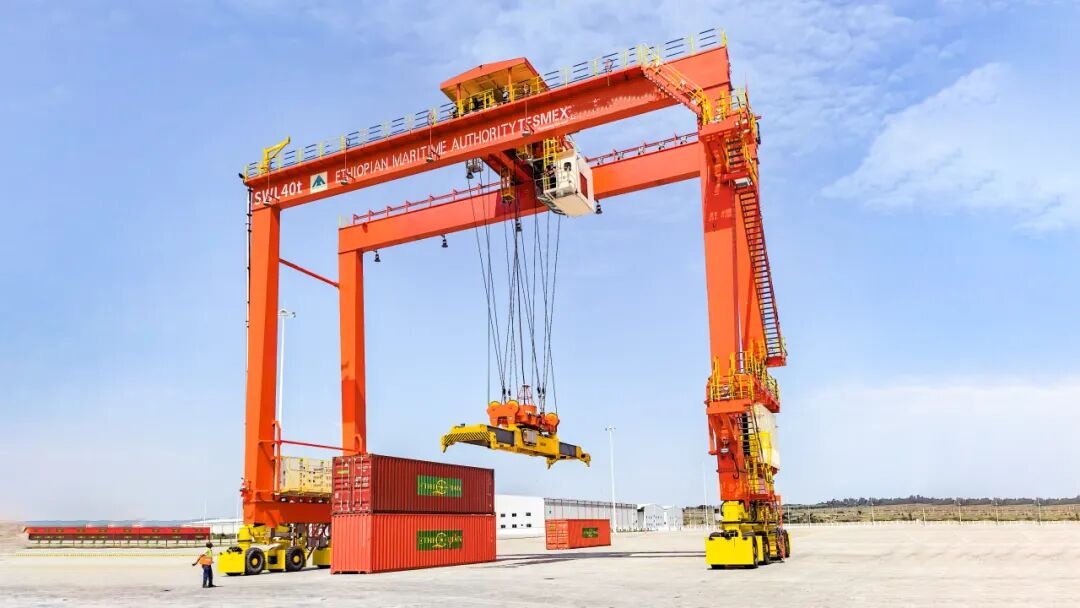
Ethiopia’s Mojo Dry Port Expansion Completed, First Container Gantry Cranes Officially Commissioned
Recently, the completion ceremony for the Mojo Dry Port expansion…